


Everyone is familiar with the term abs: it refers to the famous six-pack at the stomach level. But did you know that these muscles are not there just for aesthetics?
The role of the abdominals
The abdominal muscles perform various important functions, including ensuring the stability and support of the spine, improving control of breathing, contributing to postural alignment, and increasing core strength. Abdominal exercises are great for toning these muscles and strengthening them so they can fulfill their functions better.

The abs are composed of 4 parts, each with a specific role:
- the transverse: stabilizes the trunk, gives a flat stomach;
- the large and small oblique: lateral tilt and rotation of the trunk;
- the major right: trunk flexion.
These different muscles allow to:
- maintain the organs located in the abdomen;
- maintain posture in general;
- perform trunk rotations;
- facilitate breathing ;
- act as a link between the lower body and the upper body;
- massage the abdominal content, to stimulate the organs and activate the transit;
- less glamorous: During “evacuation” (defecation and vomiting), the abdominal pressure compresses the organs that need to be emptied;
- cherry on the cake: sculpting the silhouette.
Well yes, the primary role of the abdominal muscles is not to make your body sexy or to give you a good reason to start weightlifting, but rather to maintain your posture and the organs that are located in your abdomen.
Abs and Core Strengthening
The planking aims to work the muscles necessary for trunk stabilization and also to make the connection between the upper and lower body. Thus, planking will strengthen the trunk stabilizing muscles, such as the abdominals (rectus, transverse and obliques) and the para-lumbar muscles.
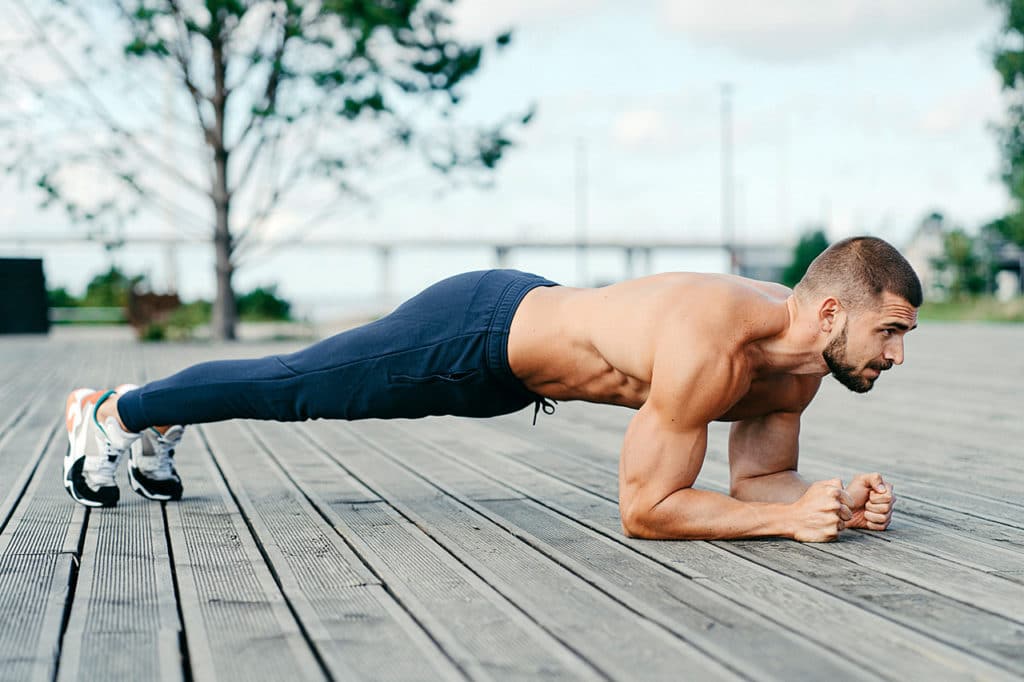
The core exercises allow the muscular reinforcement of the deep abdominals. They provide a flat stomach and protect the intervertebral discs by ensuring a tonicity of the back. They ultimately have a role in balancing the moving body and promoting the transmission of impulse forces. It is a matter of isometric muscle work (we maintain a position without moving).
This helps you move more efficiently and maintain proper alignment, which can help reduce back pain and improve posture. In addition, they support the organs in the abdomen, including the stomach and intestines. Having a strong abdomen helps to keep these organs in the right place, which can contribute to reducing digestion problems and even preventing hernias.
In addition to supporting your posture and body parts, strong abdominal muscles also play a vital role in exercise performance. They are essential for most activities requiring strength and power, such as running, jumping, swimming and weightlifting. The abdominals act as a power center, helping to coordinate movement between the upper and lower body. A strengthened abdominal belt improves balance and stability, thereby reducing the risk of injury. Additionally, strong abdominals can contribute to better breathing and greater efficiency in cardiovascular activities by supporting the rib cage and improving respiratory mechanics.
It is therefore important to incorporate exercises targeting this specific area into your training routine, making sure to vary the exercises to engage all the muscles of the abdominal belt, including the obliques and the deep muscles of the transverse.