
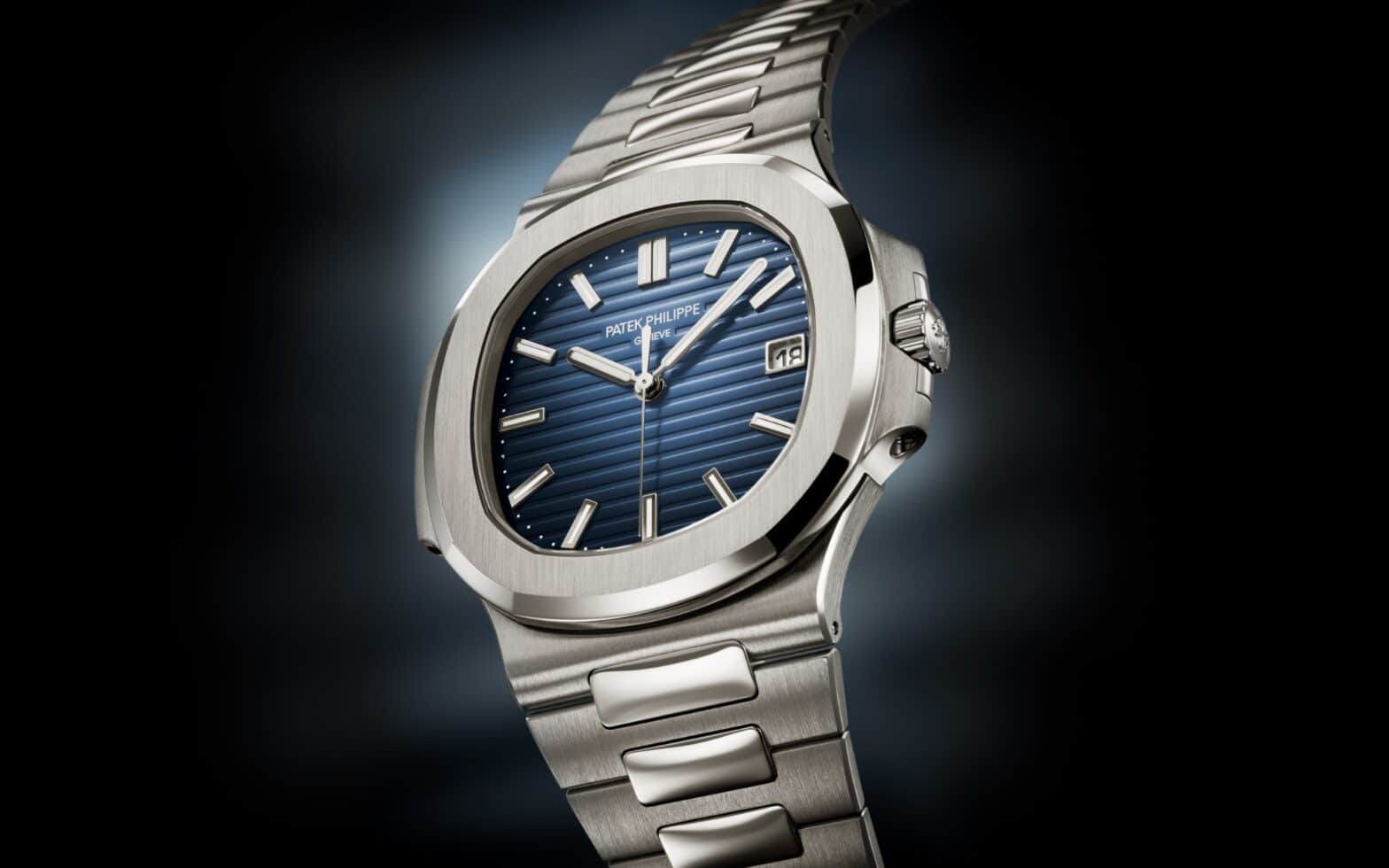

Next to Rolex’s Submariner, Omega’s Moonwatch or even Audemars Piguet’s Royal Oak, Patek Philippe’s Nautilus is without a doubt THE most coveted watch by watchmaking enthusiasts and collectors.
But for this, one needs a certain budget, since the average resale price of a Nautilus is generally between 60,000 and 200,000 euros on the second-hand market… or even much more for some limited editions. Is this due to a simple fashion trend or is the rush for this watch justified? We will try to understand in this article why this Patek Philippe has become one of the most sought after timepieces of the moment.
A watchmaking icon designed by Gérald Genta
If the 1970s were marked by the quartz crisis, this decade also saw the birth of some of the most emblematic models of contemporary watchmaking. And in particular, the Nautilus.
First introduced in 1976, this steel watch represents a bold departure from the traditional codes of luxury watchmaking. Its creation, inspired by the porthole of a ship, is the work of the genius designer Gérald Genta, 4 years after a certain Royal Oak. It was born from a desire to combine functionality and elegance, with a touch of sportiness. Certainly classical terms today, but which then represented a significant turning point for Patek Philippe, the Swiss house being renowned at the time for its classical dress watches.
With hindsight, we can say that Genta’s influence not only redefined the aesthetics of Patek Philippe but also established a new paradigm in the design of luxury watches.

How is the Nautilus a “different” watch?
The mere name of Gérald Genta would be enough to turn an ordinary watch into a cult model. But if the Nautilus has reached such a status today, it’s obviously not because of gratuitous name dropping.
It’s been said that its design literally broke the watchmaking codes in the 1970s. Its all-steel case, inspired by the porthole, is secured by four side screws, to ensure perfect waterproofing. Moreover, history tells us that the very name of the model, Nautilus, is a nod to the brand owners’ passion for the nautical universe.
Wider than the Royal Oak, the case of the Nautilus (42 mm for the first ref. 3700/1A) remains relatively thin, but it’s especially its bezel that catches the eye, octagonal with curved sides.

The dial, traditionally blue, also gets a special treatment, with a horizontal pattern that captures the light and adds to the watch’s unique aesthetic. Minimalist, the original model is content with two hands (not even a second hand) with the only complication being a date window located at 3 o’clock.
The stainless steel bracelet, perfectly integrated and fitted with a deployant clasp, contributes to the smooth and elegant silhouette of the watch. And because Patek Philippe is not one to neglect details, the exemplary finishes tend to bring the Nautilus closer to perfection.


It is amusing to note that the peculiarities of this watch are all at the stylistic level. The strictly horological part is most often relegated to the background when it is not totally overlooked. However, it should be known that the first Nautilus is powered by an automatic 28-255 movement developed by Jaeger-LeCoultre, very thin and offering some 48h of power reserve. Despite everything, giving so little consideration to the mechanism of one of the most expensive watches in the world today is quite ironic…
How to explain such a surge in prices?
Already at the time, the communication of the Calatrava cross brand reinforces the idea that this timepiece is not like the others: “One of the world’s costliest watches is made of steel.” Or, in French in the text: “One of the most expensive watches in the world is made of steel.” And to think that at the time only “about” 15,000 francs were needed…
In 2006, for the 30th anniversary of its flagship model, Patek unveils its reference 5711. Faithful to the original Nautilus, but with a few noteworthy additions (such as a second hand!), it quickly became the new star of the market. And if this new variation met with great success, it also allowed the public to rediscover vintage references, so much so that prices for the Nautilus tended to soar “very slightly”. And this regardless of the version or year of the vintage.
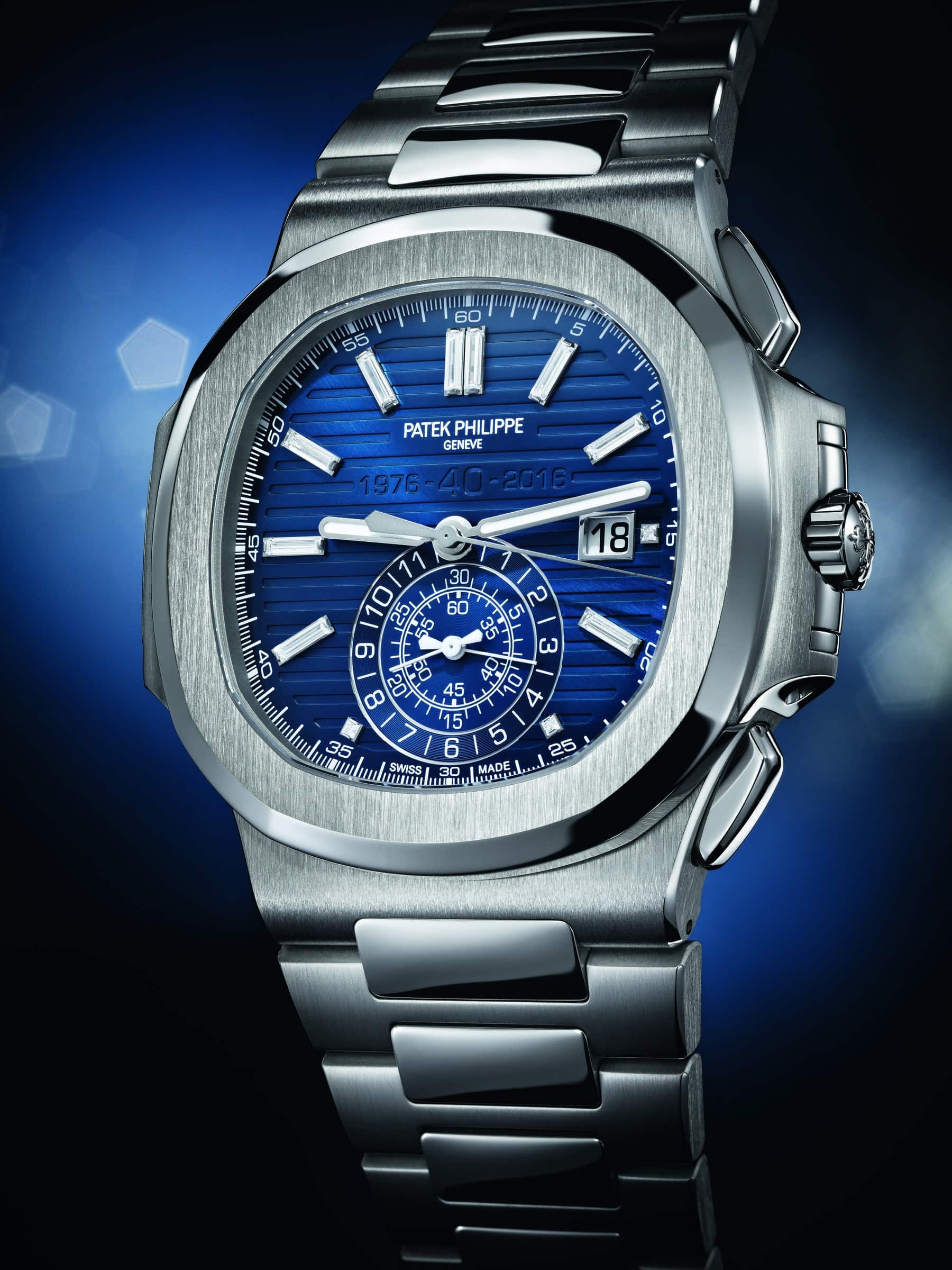
Of course, the historic reference 3700/1A from the 1970s is one of the most sought after and it is not unusual to see it cross the 200,000 euros mark. In November 2023, a Nautilus “Jumbo” 3700 in platinum and diamond dressed with a Gay Frères bracelet was even auctioned off at 1.68 million euros. And if we trust an indicator like that of WatchCharts (which we have already talked about here), a model like the 5976/1G launched in 2016 for the 40th anniversary of the Nautilus sees its rating approach 450,000 euros, or 5 times its initial selling price.
Even for the most “accessible” versions, don’t expect to find a Nautilus for less than 60,000 euros, like the 5726A with its annual calendar and moon phase indicator.
On the side of new watches, more than the prices themselves, it’s the delay that has the ability to cool enthusiasm. A wait of 8 to 10 years is often mentioned for customers who would like to acquire a new Nautilus. A delay that is also explained by the time needed to assemble a watch (several months!) as well as the low production of Patek Philippe, since less than 60,000 watches come out each year from the Geneva manufacturer. And like with the competition, the best way to join this waiting list is to already be a Patek customer and therefore already own a Nautilus… Hence the fact that collectors and investors are rushing to the second-hand market, contributing to the surge in prices.

As the Nautilus is set to celebrate its 50th anniversary in 2026, and even if the speculative bubble could burst, it is hard to imagine the hype completely deflating. Whether it’s the 3700 and 5711 models, the gold 5990, or even the 7118 adorned with precious stones, the (small) thirty variations offered by Patek Philippe help reinforce the myth of this watch designed by Gérald Genta.