


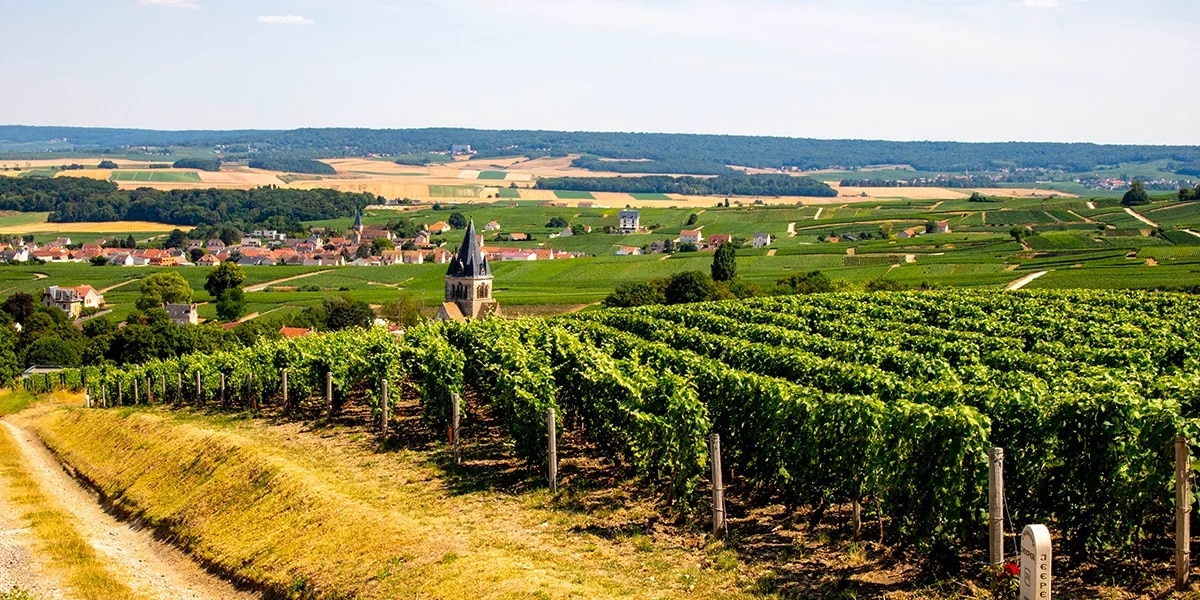
The Champagne region is world-renowned for its unique sparkling wine, Champagne. Located in the northeast of France, it benefits from a cool climate and a wide variety of soils that contribute to the quality and uniqueness of its wines. The main viticultural areas of the region are the Montagne de Reims, the Côte des Blancs, the Vallée de la Marne, and the Côte des Bar.
Grape Varieties
The grape varieties most commonly used for the production of Champagne are the Chardonnay, the Pinot Noir and the Pinot Meunier. Chardonnay brings elegance, finesse and freshness to the wines, while Pinot Noir provides structure, power and complexity. Pinot Meunier, on the other hand, brings fruity aromas and a certain roundness.
Some well-known houses and champagnes
Moët & Chandon : one of the most famous Champagne houses, founded in 1743. It produces iconic cuvées such as Dom Pérignon and Brut Impérial.
Veuve Clicquot: founded in 1772, this house is particularly known for its La Grande Dame cuvée and its Brut Carte Jaune.
Bollinger: a house renowned for its characterful Champagnes, including the Grande Année and the Special Cuvée.
Krug: a prestigious house producing exceptional cuvées, such as Grande Cuvée and Krug Vintage.
Taittinger: another house renowned for its elegant and refined Champagnes, with cuvées such as Comtes de Champagne and Brut Réserve.
Typicity
Champagne is a unique sparkling wine, produced using the traditional Champagne method, which involves a second fermentation in the bottle. Champagnes can be white or rose and come in a variety of styles: non-dose, extra brut, brut, extra-dry, dry, medium-dry, and sweet, depending on their sugar content. They generally have fine and lasting bubbles, a pronounced acidity and complex aromas of fruit, flowers, brioche, and hazelnut.
Type of Soil
The soil of the Champagne region is mainly composed of chalk, a white limestone that retains water and ensures good drainage. This type of soil enhances the freshness and acidity of the wines, as well as their finesse and elegance. There are also clay-limestone soils, particularly in the Côte des Bar, which provide a certain richness and fruity character to the wines.

In summary, the Champagne region is famous for its iconic sparkling wine, produced from grape varieties such as Chardonnay, Pinot Noir, and Pinot Meunier. Among the most well-known houses and wines are Moët & Chandon, Veuve Clicquot, Bollinger, Krug, and Taittinger. Champagnes from the region are characterized by their finesse, elegance, and aromatic complexity, thanks to the traditional Champagne method and chalky and clay-limestone soils.
The typicality of Champagnes varies according to styles and sugar dosages, but they generally present a marked acidity, fine and persistent bubbles, as well as aromas of fruit, flowers, brioche and hazelnut.
Champagne is also a region, straddling between the Marne and the Aube, rich in history and viticultural culture, with many tourist sites to discover, such as the Reims Cathedral, the Tau Palace and the Champagne avenue in Épernay.
Furthermore, winery tours and tastings in vineyards provide an opportunity to learn more about the production methods and secrets behind this globally appreciated sparkling wine.
Finally, Champagnes are very versatile wines, which can be enjoyed as an aperitif, to accompany refined dishes, or to celebrate special events. Their ability to enhance many dishes, ranging from seafood to cheeses, via white meats and desserts, makes them exceptional wines, appreciated by both enthusiasts and connoisseurs.
Thus, the Champagne region continues to fascinate and seduce with the quality and diversity of its wines, the result of ancestral know-how and exceptional terroir. Wine enthusiasts from around the world are attracted to this unique region, eager to discover the secrets of making Champagne and to taste this precious nectar in its original environment.