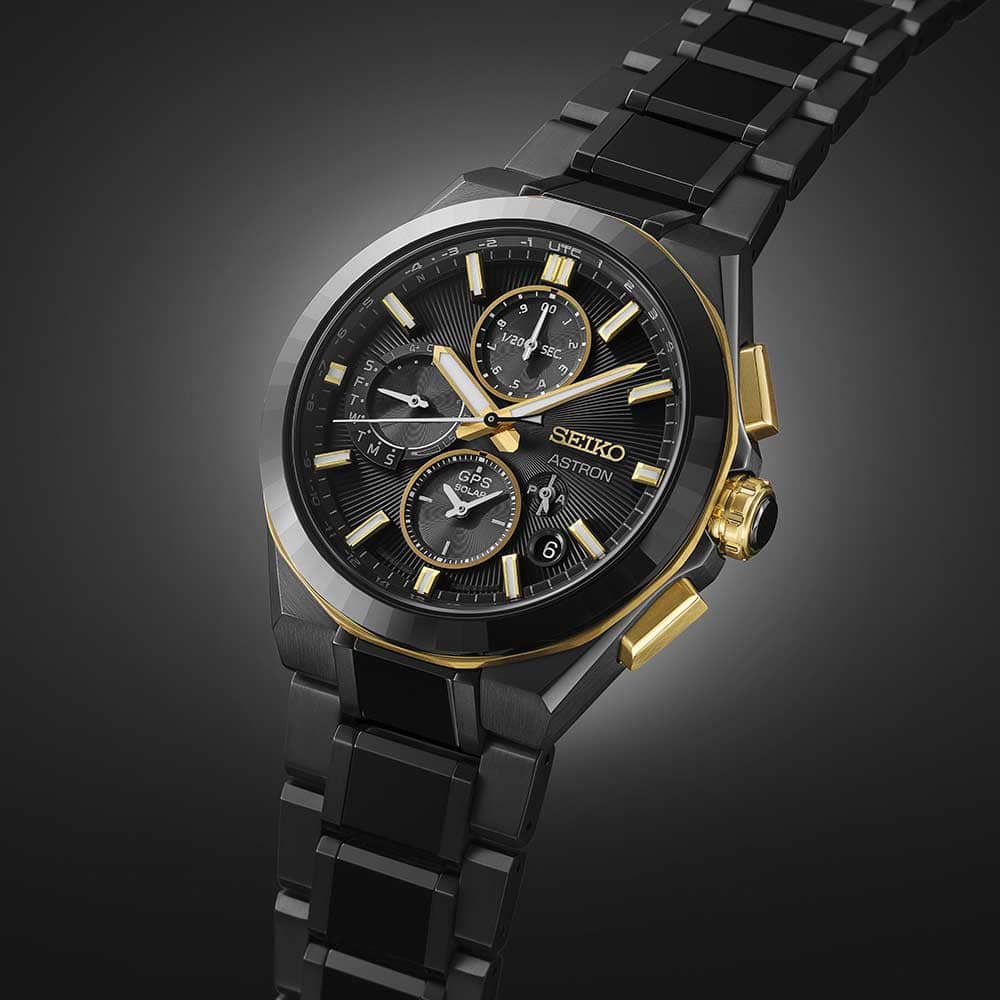


The Cartier Santos is the first wristwatch in history. The Fifty Fathoms by Blancpain is the first modern diving watch. The Omega Speedmaster is the first watch to have gone to the Moon… Among all these watches that have made history, there is one that is somewhat unloved. And with good reason: the Seiko Astron was at the heart of an unprecedented crisis in the 1970s. But this first quartz watch has above all completely reshaped the modern watchmaking industry. 55 years after its launch, it is therefore time to revisit the history of this unique model.
The first steps of the electric watch
If we necessarily associate the battery-powered watch with the name of Seiko, the adventure of electric watchmaking began well before the launch of the Astron.
From the 1950s, we began to see the first explorations aimed at shifting mechanical oscillation to electrical impulse. Thus, in 1952, the American brand Elgin Watch and its French counterpart Lip announced the development of a battery-powered watch. The following year, in the United States again, Bulova filed a patent for a tuning fork watch.
One of the most iconic milestones of this era was then set in 1957 by Hamilton with its Ventura, now known to be the first electric watch in the world. It represents a bold first attempt to break away from traditional mechanical workings, using an electric movement to enhance the precision of time measurement.
However, these early forays into electric only lay the foundations for what will become a real revolution with the arrival of quartz.
The lovely (poisoned) Christmas gift from Seiko in 1969
After the development of a first quartz clock for the broadcasting company, Seikosha understands that this technology could give rise to a new generation of watches. It would still take a few years of work to see the first Suwa Seikosha quartz pocket watch rewarded by the Neuchâtel Observatory in 1967, and then to witness the creation of the 31EL in 1968, the first battery-powered wristwatch, equipped with a lever escapement.
At that time, the Japanese company announced that it had completely abandoned research on tuning forks and claimed that its first quartz watch would be ready a year later.
What looks like a vain promise eventually confirms itself at the very end of 1969. Specifically on December 25th, the day Seiko announced the sale of the Astron 35SQ, the first quartz watch in the world available to the general public.

This innovation marks a decisive turning point, with quartz offering unmatched precision compared to mechanical watches of the time. Astron is not just a technical wonder, it is also a commercial revolution, signifying the beginning of the modern era of watchmaking for many. In the Old Continent, Seiko’s innovation is seen as a “poisoned gift”, precipitating what we now call the “quartz crisis”.
This period sees many traditional watch manufacturers struggling to compete in the market due to the technical superiority and lower cost of quartz watches. It doesn’t take long to understand that the Seiko Astron is going to contribute to reshaping the watch landscape, pushing the industry towards an era of electronic precision… and a strategic reassessment. In 1982, more than one in two watches produced worldwide is a quartz watch.
💡The article to read to understand everything about the quartz crisis in watchmaking

What remains of the Seiko Astron today?
More than half a century after its arrival on the market, the Astron still has a say, even if it hardly resembles the original model anymore. And since quartz watches rub shoulders with mechanical watches at most of the major brands (much to the chagrin of purists), Seiko has decided to go further.
In 2012, the Japanese firm launched the second generation of Astron, this time as the world’s first solar GPS watch. This new version, while preserving the brand’s legacy in terms of accuracy and reliability, incorporates cutting-edge technologies that reflect the continuous evolution of watchmaking. Recent models are capable of connecting to GPS satellites to adjust the time with atomic precision, wherever you are on the planet.
Year after year, Seiko continues to refine its technology. More compact, more precise, less power-consuming, the movement that powers the Astron is becoming increasingly sophisticated, as evidenced by the 5X series launched in 2018. And in 2024, for the 100th anniversary of the first Seiko-branded watch, the Astron is equipped with the new 5X83 calibre, which allows it to marry a classic chronograph with the GPS Solar Dual-Time technology for the first time. Proof that even today, this reference continues to surprise us!