
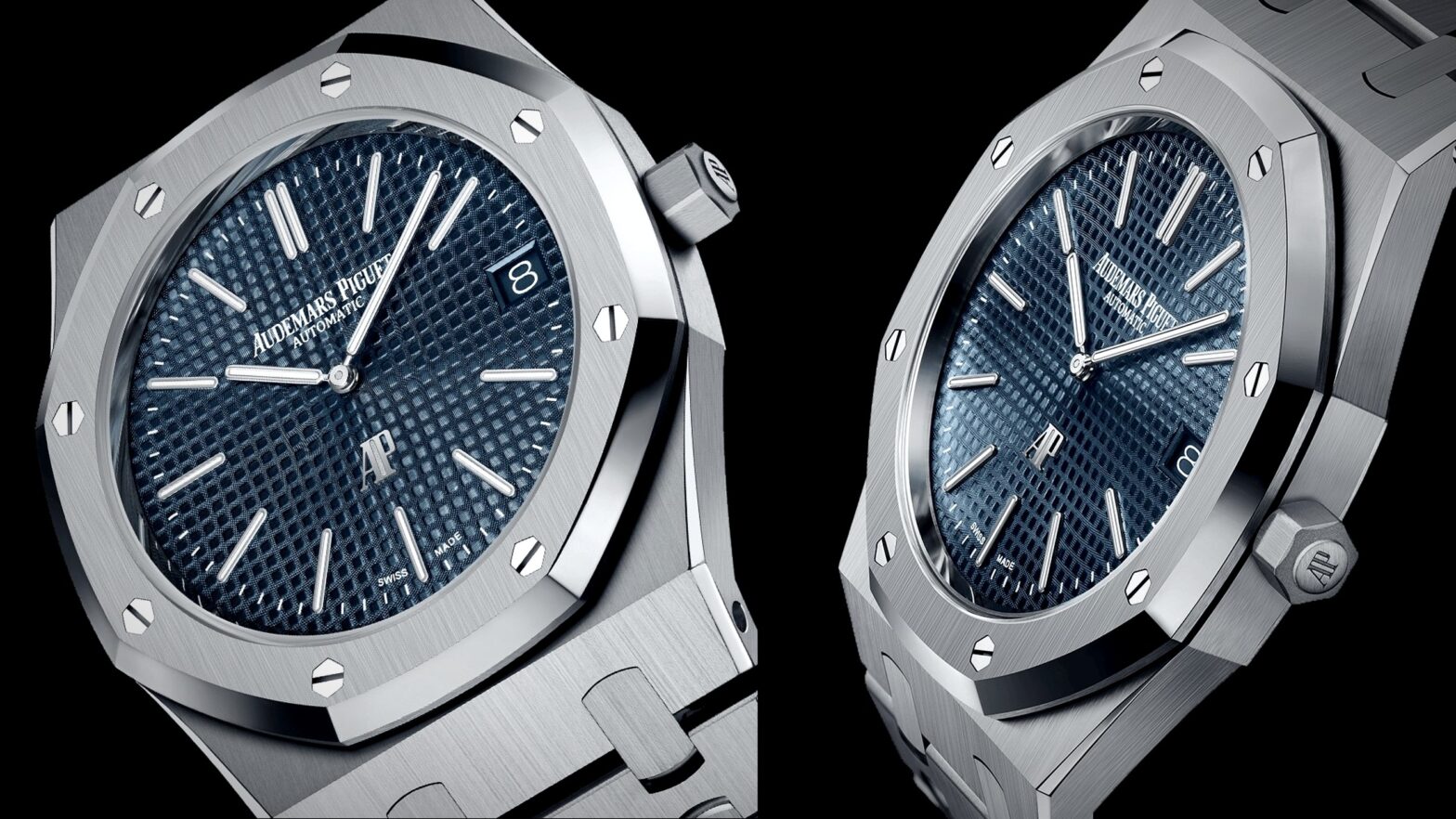

In the small world of iconic watches that make collectors dream, some models clearly stand out. The Omega “Moonwatch” Speedmaster, the Rolex Submariner or the Patek Philippe Nautilus are obviously part of them. But if there’s one that’s been attracting the covetousness of collectors and speculators for a few years, it’s the Audemars-Piguet Royal Oak.
How can we explain the frenzy surrounding this watch? We’re going to try to understand how the 1970s steel sports watch became a must-have for watch enthusiasts (and show-offs).
The origins of the Royal Oak
At the beginning of the 1970s, the advent of the Royal Oak was less an introduction than a revolution. At a time when Swiss horology feels the icy breath of the quartz crisis, Audemars Piguet decides to honour its status as a daring and visionary house by taking an unexpected turn.
The Brassus house decides to call upon the creative genius of Gérald Genta, designer of watches such as the Polerouter from Universal Genève or the Constellation from Omega. At this point, no one yet imagines that this collaboration will lead to a watch that will redefine not only the Audemars-Piguet brand, but also (and above all) the entire watchmaking industry.
The story tells that Gerald Genta imagined the design of the Royal Oak in just one night. A luxury watch with an octagonal case, topped with a screwed bezel reminiscent of the portholes of a ship. This aesthetic audacity is reinforced by the use of a material that was then little valued for high-end watchmaking: steel. Immediately, the “simple” sports timepiece becomes a symbol of rebellion against conventions.
Gérald Genta, about the creation of the Royal Oak
Gérald Genta, about the creation of the Royal Oak
Gérald Genta, about the creation of the Royal Oak
Thus begins in 1972 the career of the Royal Oak, not only as a watch, but as a symbol of a new era.

The reasons for success
Rebellious, the Royal Oak most certainly is. But precisely, this image does not please everyone in the hushed universe of watchmaking. How can a watch made of steel, such a common material, claim to have a luxury label? And above all, how can one imagine that such a watch could be worth such a price?
However, what is first perceived as an oddity, turns into a visionary creation. With the Royal Oak, steel is no longer just a secondary material, it embodies sporty elegance. Another face of luxury. It is indeed no coincidence that Gérald Genta repeated this in 1976 with the Nautilus designed for Patek Philippe…
Once the skepticism associated with the use of steel faded, the master designer’s touch eventually prevailed. The geometry of its case, the harmony of its Tapisserie dial, and its integrated bracelet make the Royal Oak a “different” watch… and recognizable among all. This new visual signature thus directly opposes the more classic watches from Rolex, Cartier or even Omega.


The most coveted versions of the Audemars Piguet watch
Naturally, over time, Audemars Piguet realized that they needed to maintain the myth around their golden goose. The Royal Oak has therefore been revisited, reinvented, and presented in a multitude of versions, more or less precious, more or less sophisticated. Famous stars and renowned ambassadors have allowed the Swiss brand to make this model even more desirable, from Leo Messi to Mark Ronson via LeBron James.
In recent years, this craze has further intensified in the second-hand market, where the value of certain references has literally soared. The speculative game contributes significantly, with the Royal Oak becoming synonymous with significant potential gain. A glance at the data from Watch Charts allows us to understand just how much certain variations of the Royal Oak have become icons among icons, editions that aficionados are scrambling for.
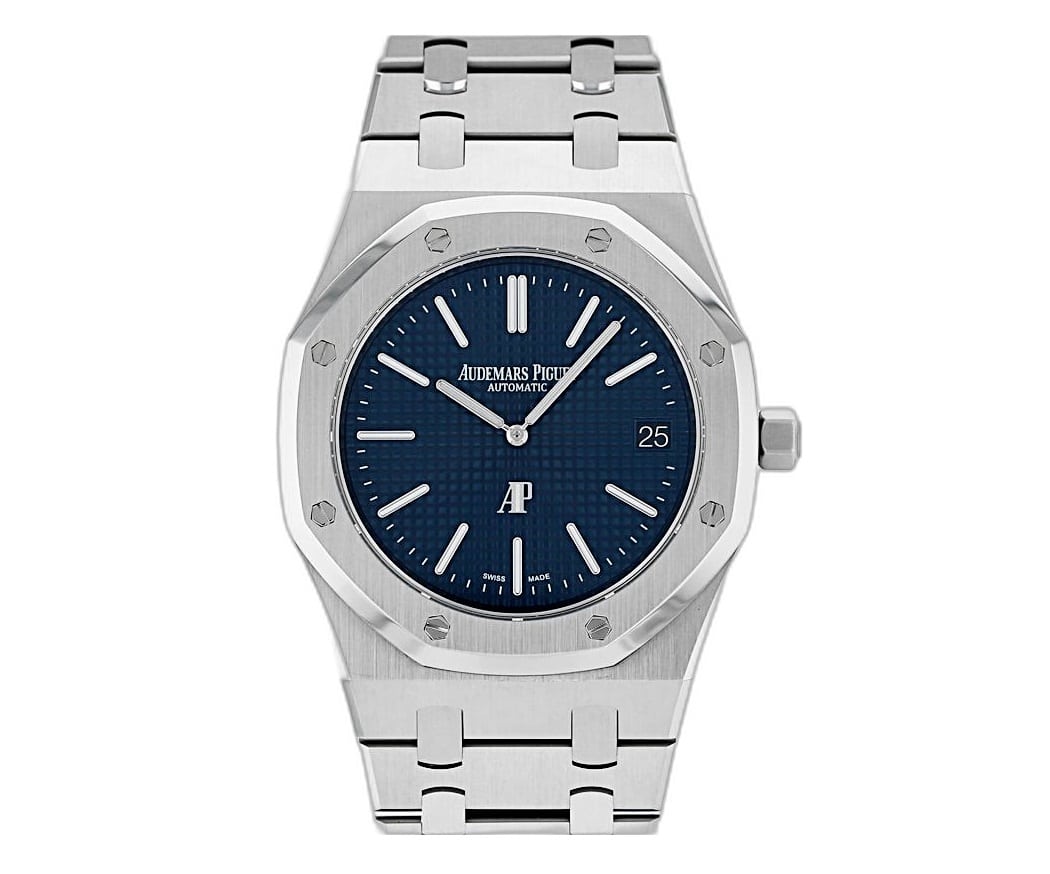
Royal Oak “Jumbo” Extra-Thin 15202ST
This is the model that most closely resembles Genta’s original drawing. Its extreme finesse and fidelity to the 1972 design make it a coveted piece, a modern relic that evokes the very essence of the Royal Oak.
Often copied, never equalled, it is obviously distinguished by its iconic 39 mm case (for 8.1 mm thickness) and its textured midnight blue dial. All with a perfectly integrated steel bracelet. Offered around 32,000 euros for a new one, its value regularly climbs to more than 50,000… even 100,000 euros, depending on the model.
Royal Oak Offshore 26470OR
With its launch in 1993, the Royal Oak Offshore introduced a new dimension of robustness and functionality. Larger, equipped with a chronograph, it is aimed at those who seek to combine the heritage of the Royal Oak with enhanced sports performance.
It takes on a more luxurious (and ostentatious?) dimension than ever in its gold version, which rarely trades for less than 50,000 euros.

Royal Oak Concept 26620IO
Finally, the Concept line embodies the spirit of innovation dear to Audemars Piguet. Each model here is conceived as a showcase of technical mastery and aesthetic innovation, offering complications and materials at the forefront of modernity.
And among the most recent contemporary variations, how not to mention the Royal Oak Concept Black Panther Flying Tourbillon in titanium, whose base price of 162,000 euros has soared to over 300,000 euros in the second-hand market?
